12-Month vs Lifetime ECL
Understand the three ECL stages, why moving to lifetime losses can sharply increase an allowance, and why ordinary trade receivables use lifetime ECL from recognition.

Xian Hui
6 November 2026 · 10 min read

In brief
What is the difference between 12-month and lifetime ECL for receivables?
12-month ECL measures lifetime cash shortfalls from defaults possible in the next 12 months. Lifetime ECL includes defaults throughout the remaining expected life. Under the general approach, a significant increase in credit risk moves a receivable from stage 1 to stage 2, widening the default horizon and potentially increasing the allowance sharply. Stage 3 means credit impairment. Trade receivables under the simplified approach use lifetime ECL from recognition.
What you'll learn
- Distinguish the default horizons used for 12-month and lifetime ECL
- Explain each ECL stage and why the allowance can jump from 12-month to lifetime ECL
- Identify when trade receivables require the simplified approach
- Distinguish the 30-day credit risk presumption from the 90-day default presumption
- Explain the allowance, impairment expense and related disclosures
12-Month vs Lifetime ECL
A customer invoice and a loan to another company can both be receivables, yet their expected credit loss (ECL) allowances may start on different bases. The difference concerns which possible defaults enter the estimate.
IFRS 9 Financial Instruments (equivalent to SFRS(I) 9 and SFRS 109) distinguishes 12-month and lifetime ECL. Credit-impaired describes the condition of the asset, rather than a third loss horizon.
SFRS for Small Entities does not use the ECL model.
What do 12-month and lifetime ECL actually count?
12-month and lifetime ECL are measured the same way: the chance of default multiplied by the loss if default happens. The only difference is which defaults are counted. 12-month ECL counts only defaults that could happen in the 12 months after the reporting date. Lifetime ECL counts defaults that could happen at any point over the instrument's expected life [IFRS 9.B5.5.43].
What are the three ECL stages?
| Stage | Applies to | What has happened | Measurement |
|---|---|---|---|
| Stage 1 12-month ECL | Loans, deposits and other receivables under the general approach. Trade receivables with a significant financing component, unless the entity has chosen lifetime ECL for them as its accounting policy [IFRS 9.5.5.15(a)(ii)]. | Credit risk has not increased significantly since initial recognition. | Loss allowance at 12-month ECL [IFRS 9.5.5.5]. |
| Stage 2 Lifetime ECL | Receivables under the general approach that have moved out of Stage 1. Trade receivables under the simplified approach, from initial recognition. | General approach: credit risk has increased significantly since initial recognition, but the asset is not credit-impaired. See When has credit risk increased significantly? below. Simplified approach: no trigger is needed. Trade receivables without a significant financing component use lifetime ECL from the day they are recorded, with no significant-increase assessment [IFRS 9.5.5.15(a)(i)]. | Loss allowance at lifetime ECL [IFRS 9.5.5.3 and IFRS 9.5.5.15]. |
| Stage 3 Credit-impaired | All receivables, including trade receivables under the simplified approach. | One or more events have harmed the asset's estimated future cash flows, for example significant financial difficulty of the debtor or probable bankruptcy [IFRS 9 Appendix A]. See What does credit-impaired mean? below. | Loss allowance stays at lifetime ECL [IFRS 9.5.5.3]. For interest-bearing assets, interest is then calculated on the amount net of the loss allowance [IFRS 9.5.4.1(b)]. |
“Stage” is common shorthand, rather than a term used in IFRS 9.
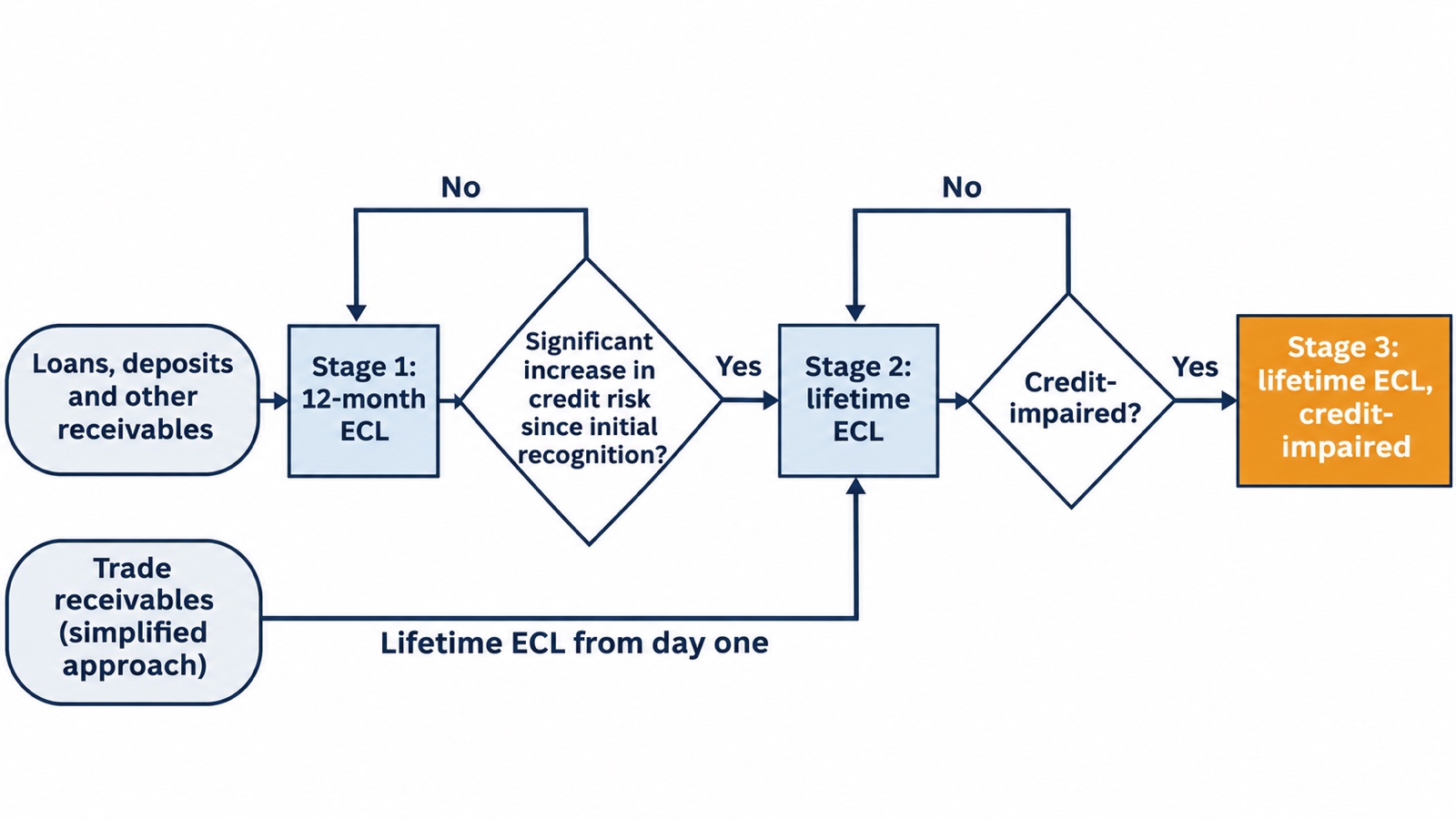
The flow chart shows how a receivable moves through the stages. Trade receivables under the simplified approach skip Stage 1.
Why does ECL jump when a receivable moves from stage 1 to stage 2?
This sketch shows how the allowance can rise as credit risk worsens. The step heights are illustrative.
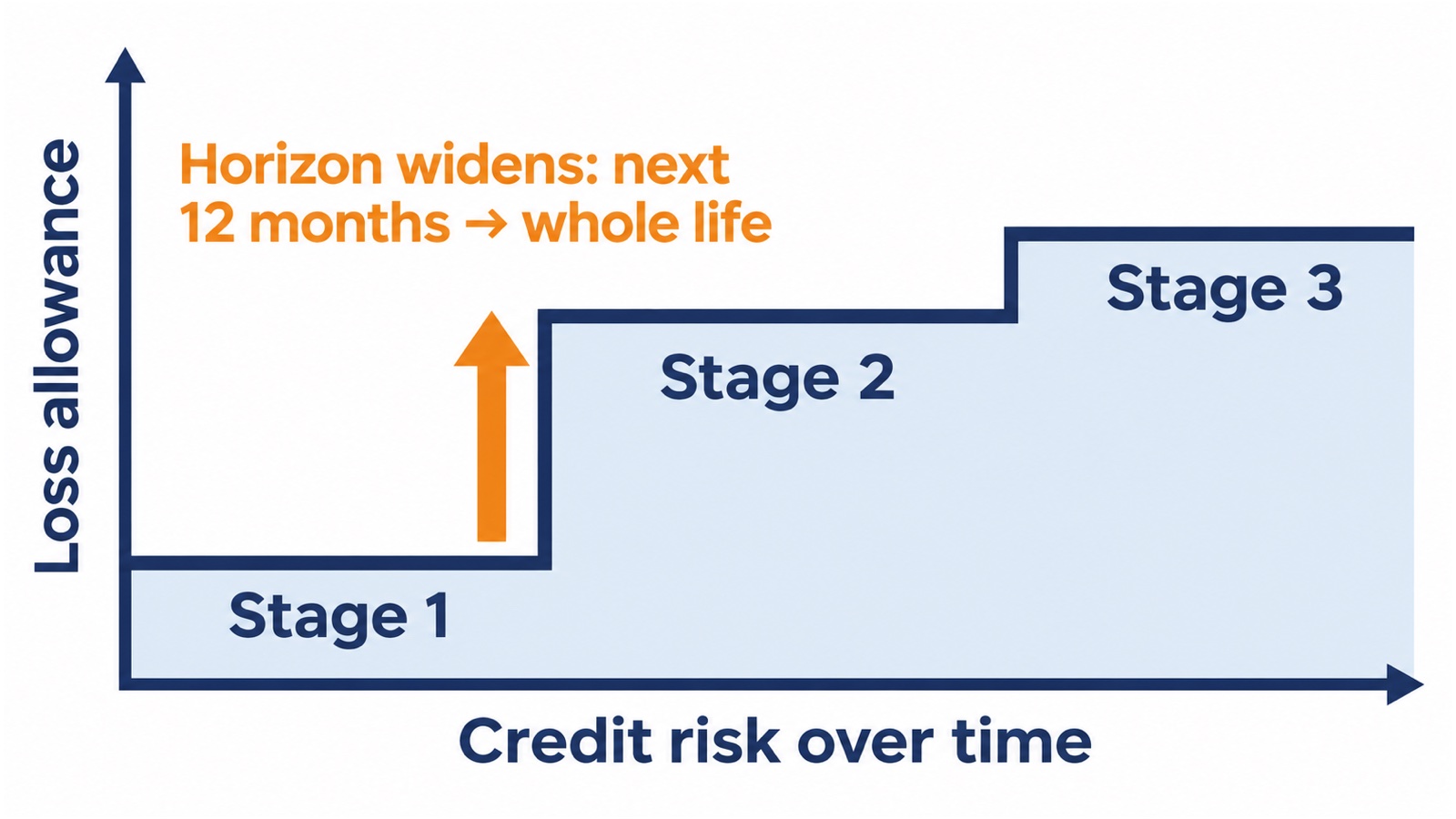
The move from Stage 1 to Stage 2 changes which possible defaults enter the allowance. Stage 1 measures lifetime cash shortfalls from defaults possible in the next 12 months. Stage 2 includes defaults possible over the whole remaining expected life [IFRS 9.B5.5.43]. The wider horizon can sharply increase ECL even though the amount the customer owes has not changed.
It is important to note that Stage 1 does not mean a zero allowance. ECL must reflect the possibility of a credit loss even when that possibility is very low [IFRS 9.5.5.18], and even when the most likely outcome is no loss [IFRS 9.B5.5.42]. For low-risk balances the amount may be immaterial, but it is not nil by definition.
The trigger is a relative assessment of credit risk, rather than a change in the amount owed. IFRS 9.5.5.9 requires comparison of the risk of default over the expected life at the reporting date with that risk at initial recognition, using reasonable and supportable information. Assess the change in default risk, rather than the change in the ECL amount. This potential “cliff” in the allowance is why the staging judgement matters: crossing the significant-increase threshold changes the measurement horizon before credit impairment necessarily occurs.
What counts as default?
Use a definition of default consistent with internal credit risk management, considering warning signs such as breaches of contract conditions (covenants). Apply it consistently unless information supports a different definition for a particular instrument [IFRS 9.B5.5.37].
By 90 days past due, default is presumed unless rebutted, which usually means the balance is treated as credit-impaired (stage 3). This is a presumption about default, rather than a definition of stage 3 [IFRS 9.B5.5.37 and IFRS 9 Appendix A, definition of a credit-impaired financial asset].
When has credit risk increased significantly?
A significant increase in credit risk (SICR) means the chance of default over the expected life has risen significantly since the receivable was first recorded (initial recognition). Compare default risk, rather than the size of the allowance [IFRS 9.5.5.9].
Use reasonable and supportable information about future conditions when available without undue cost or effort [IFRS 9.5.5.11]. Warning signs include expected credit rating downgrades, weaker trading and changes in payment behaviour [IFRS 9.B5.5.17].
More than 30 days past due presumes SICR and requires at least stage 2 unless rebutted. This is the latest presumed point: use lifetime ECL earlier when forward-looking evidence identifies SICR [IFRS 9.5.5.11 and IFRS 9.B5.5.19].
The low credit risk simplification allows an assumption of no SICR when default risk is low and the borrower has a strong capacity to pay in the near term [IFRS 9.5.5.10 and IFRS 9.B5.5.22]. Collateral (assets securing repayment), or a comparison with riskier borrowers, does not by itself establish low credit risk [IFRS 9.B5.5.22].
What does credit-impaired mean?
An asset is credit-impaired when one or more events have harmed its estimated future cash flows. It does not automatically mean that nothing will be recovered.
Evidence listed in the standard includes significant financial difficulty of the borrower, a breach of contract such as a default or past due event, a concession granted because of that difficulty, and bankruptcy becoming probable [IFRS 9 Appendix A, definition of a credit-impaired financial asset].
Default is therefore one of the events that show credit impairment. This is why a balance in default, including one presumed to be in default at 90 days past due, is usually treated as Stage 3. Stage 3 can also arise before any default, for example when bankruptcy becomes probable before a payment is overdue.
Significant increase in credit risk and default presumptions
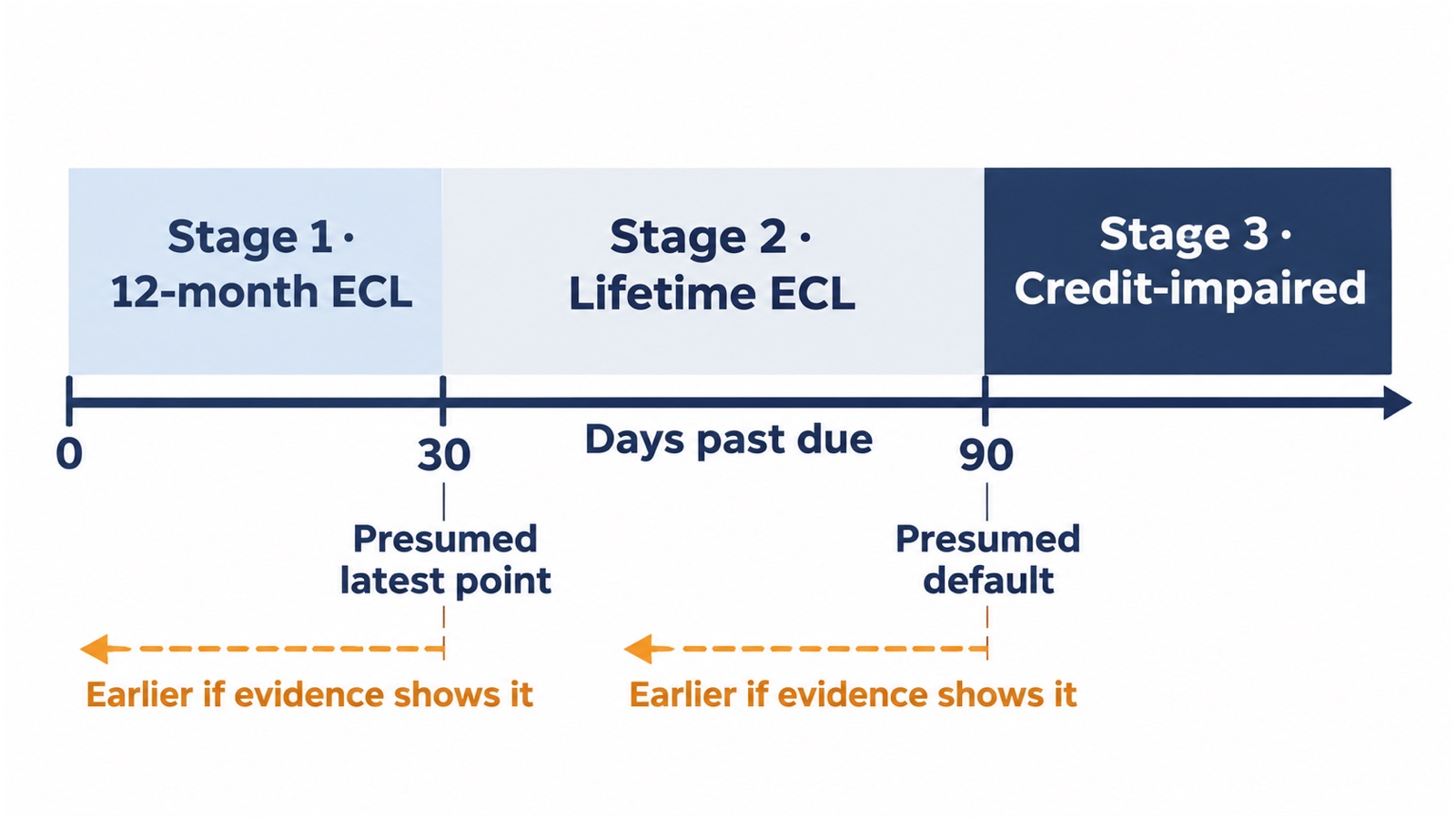
While the stages describe credit risk, rather than how many days a payment is overdue (past due), the standard does provide rebuttable presumptions when a significant increase in credit risk and defaults occur. The 30-day and 90-day rules are safety nets: they set the latest presumed points for increased credit risk and default, but evidence can overturn them (rebuttable presumptions) [IFRS 9.5.5.11, IFRS 9.B5.5.19 and IFRS 9.B5.5.37].
Use this table for the general approach [IFRS 9.5.5.3, IFRS 9.5.5.5 and IFRS 9 Appendix A, definition of a credit-impaired financial asset].
| Stage | What has happened | Allowance measured at | Latest point (rebuttable presumption) | Can it happen earlier? |
|---|---|---|---|---|
| Stage 1 | No significant increase in credit risk | 12-month ECL | No fixed day threshold | Starts when first recorded |
| Stage 2 | Significant increase in credit risk, but no credit impairment | Lifetime ECL | More than 30 days past due: increased credit risk presumed | Yes, even before payment is overdue |
| Stage 3 | Credit-impaired: events have harmed estimated future cash flows | Lifetime ECL | By 90 days past due: default presumed. Usually credit-impaired | Yes, for example if bankruptcy becomes probable |
The arrows show why a stage change can come before the dates shown. The dates are safety nets, not a timetable.
When can you rebut a presumption?
To rebut a presumption, show why its assumed conclusion does not apply. Both presumptions require reasonable and supportable evidence, but they ask different questions [IFRS 9.5.5.11, IFRS 9.B5.5.20 and IFRS 9.B5.5.37].
| Presumption | What you need to rebut it |
|---|---|
| More than 30 days past due: credit risk has increased significantly | Evidence that credit risk has not increased significantly, for example a payment missed through an administrative oversight [IFRS 9.B5.5.20]. |
| Default no later than 90 days past due | Evidence showing why a later default criterion is more appropriate for the instrument [IFRS 9.B5.5.37]. |
Do these rules apply to trade receivables under the simplified approach?
Trade receivables under the simplified approach use lifetime ECL from recognition, so there is no stage 1 to stage 2 switch in the measurement horizon [IFRS 9.5.5.15(a)]. The default definition still matters when estimating losses and identifying credit-impaired balances [IFRS 9.B5.5.35, IFRS 9.B5.5.37 and IFRS 9 Appendix A].
Why do ordinary trade receivables start at lifetime ECL?
IFRS 9.5.5.15(a)(i) requires lifetime ECL for trade receivables from customer revenue transactions without a significant financing component. This simplified approach avoids assessing whether credit risk has increased enough to switch horizons. It applies from initial recognition and includes invoices that are not overdue.
Commercially, the business already needs to estimate what it will collect from its outstanding invoices. For an exposure with an expected life shorter than 12 months, the default horizons coincide. A staging exercise would add little information.
The requirement also covers the financing practical expedient in IFRS 15 Revenue from Contracts with Customers (equivalent to SFRS(I) 15 and SFRS 115). IFRS 15.63 permits that expedient where the expected transfer-to-payment interval at contract inception is one year or less.
For trade receivables with significant financing, lifetime ECL is an accounting policy choice under IFRS 9.5.5.15(a)(ii). Apply that policy consistently to all such trade receivables. Otherwise, the general approach applies. Calling a balance “trade” does not settle the question.
How can a provision matrix estimate trade receivable losses?
A provision matrix applies loss rates to groups of receivables with shared credit risk characteristics, often using ageing bands. IFRS 9.B5.5.35 permits this practical expedient. An ageing schedule provides structure, but cannot supply the loss rates by itself.
Use historical collection experience, adjust for present conditions and reasonable forecasts, and consider specific troubled customers. IFRS 9.5.5.17 requires an unbiased, probability-weighted estimate reflecting the time value of money and supportable information. Applying lifetime ECL never means providing for every invoice in full.
How does ECL appear in the financial statements?
For receivables measured at amortised cost, the loss allowance reduces the net carrying amount. Recognise the adjustment needed at each reporting date as an impairment loss or reversal in profit or loss [IFRS 9.5.5.8]. For interest-bearing assets that subsequently become credit-impaired, IFRS 9.5.4.1(b) changes subsequent interest calculation to the amount net of the allowance.
IAS 1 Presentation of Financial Statements (equivalent to SFRS(I) 1-1 and SFRS 1) requires an impairment line item, subject to materiality, in IAS 1.82(ba). Its successor, IFRS 18 Presentation and Disclosure in Financial Statements (equivalent to SFRS(I) 18 and SFRS 118), retains that requirement in IFRS 18.75(b)(ii). IFRS 18 applies for annual periods beginning on or after 1 January 2027, with earlier application permitted [IFRS 18.C1].
IFRS 7 Financial Instruments: Disclosures (equivalent to SFRS(I) 7 and SFRS 107) requires explanations of credit practices, estimation assumptions and allowance movements [IFRS 7.35F, IFRS 7.35G and IFRS 7.35H]. These connect the accounting estimate to the credit decisions that make ECL commercially useful.
Frequently asked questions
This information has been prepared for general informational purposes only and is not intended to be relied upon as accounting, tax, or other professional advice.


