Follow each trigger through ECL Stages 1, 2 and 3. See why trade receivables on the simplified approach begin at Stage 2.
Luca Briefs1/10
Expected credit loss
Three ECL stages. What moves a receivable?
Follow a balance from first booking to rising default risk and credit impairment. Trade receivables on the simplified approach start further along.
General approach at a glance
Stage 1 to Stage 2 to Stage 3
1Stage 1. First booking starts the 12-month ECL window.
2Stage 2. A significant rise in default risk brings lifetime ECL.
3Stage 3. Events that harm expected cash flows make it credit-impaired.
Stage 1 begins
First booking is the starting trigger
Book loans and deposits, plus other receivable balances, in Stage 1 under the general approach. Start with 12-month ECL. The year selects possible defaults, whose losses can extend beyond it.
Stage 1 to Stage 2
Has lifetime default risk risen significantly?
Compare today's default risk over the balance's expected life with its risk at first booking. A significant rise moves it to Stage 2. It is not yet credit-impaired. Use lifetime ECL.
30-day backstop
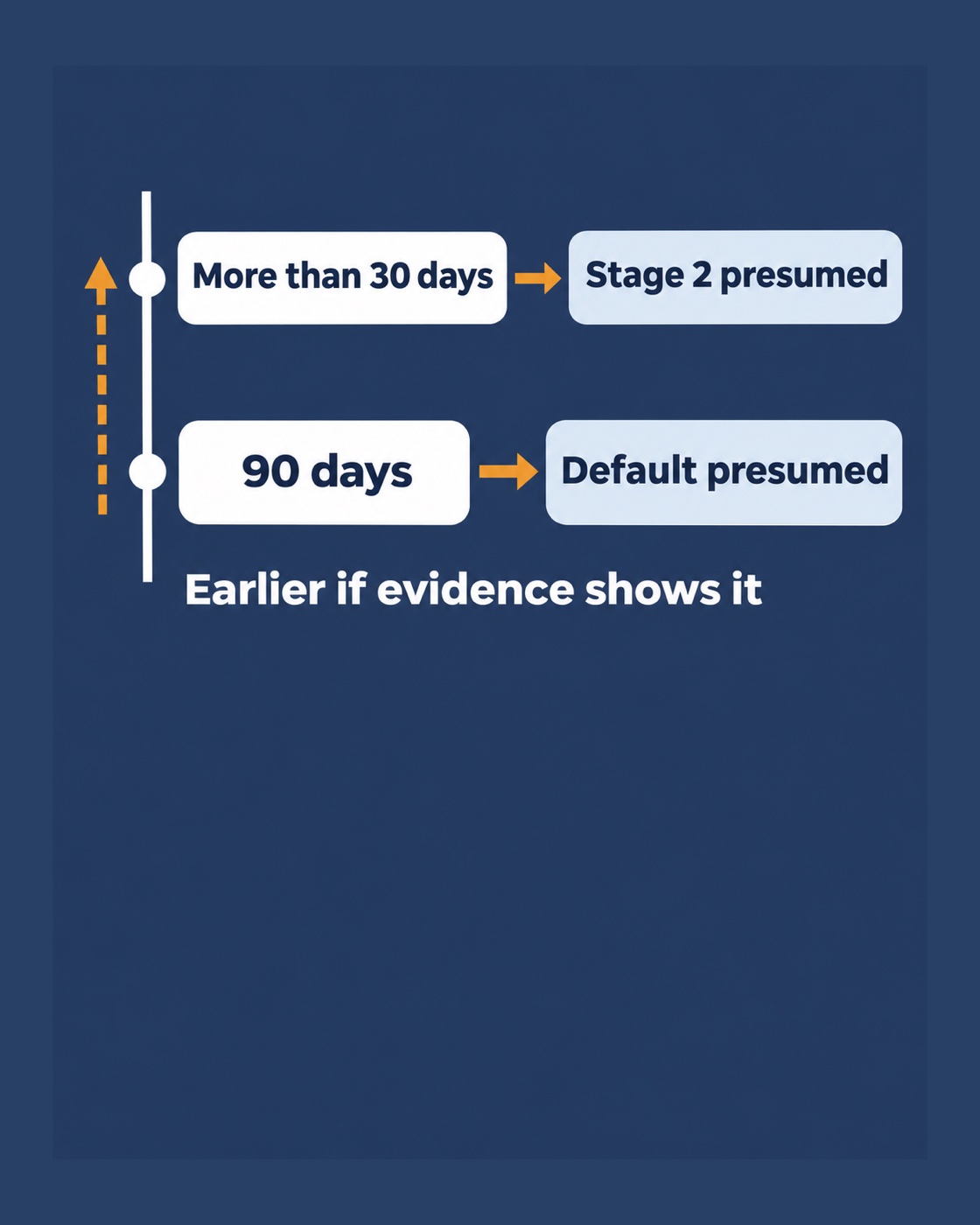
Over 30 days late? Presume a significant risk rise
Under the general approach, more than 30 days late means assuming a significant risk rise and at least Stage 2. Sound, supportable evidence can rebut it. Warning signs can require an earlier move.
The allowance jump
Same balance. More possible defaults to count.
Stage 1 looks one year beyond reporting for possible defaults. Stage 2 counts them across the balance's remaining life. A wider window can push up ECL even when the amount owed stays the same.
Stage 2 to Stage 3
Credit-impaired is the trigger
1Serious money troubles for the debtor.
2A broken contract, such as a default or missed payment.
3Payment terms eased because the debtor is in money trouble.
4A debtor now likely to go bankrupt.
Move to Stage 3 when events harm the cash flows you expect to receive. Keep using lifetime ECL. Signs include:
90-day backstop
By 90 days late, presume default
Default and credit impairment differ, though default usually means Stage 3. Sound, supportable evidence can justify a later default point. Stage 3 can arise before payment is late.
Simplified approach
Trade receivables start at Stage 2
1Compulsory if financing is not significant.
2If financing is significant, the method is a policy choice.
3Even an invoice that is not yet due starts here.
4Move to Stage 3 if the balance becomes credit-impaired.
Trade receivables on this approach use lifetime ECL from day one. There is no test for a significant rise in risk.